Building a Mini SOC: Wazuh Detection & Automated Response Lab
📌 Executive Summary
A Security Operations Center (SOC) depends on more than simply collecting logs; it requires transforming telemetry into actionable intelligence and immediate containment.
This project demonstrates the end-to-end engineering of a miniature SOC environment. By simulating real-world attacks (Red Team) and implementing automated defenses (Blue/Purple Team), this lab showcases a workflow that demonstrates how automated response can reduce containment time from manual intervention to near-immediate machine execution.
Key Achievements:
- Configured Windows File Integrity Monitoring (FIM).
- Correlated SMB brute-force attacks to MITRE ATT&CK frameworks.
- Automated IP blacklisting via Wazuh Active Response.
- Conducted a monitoring gap analysis to define future network telemetry needs.
🛠️ Tools & Methodology
- SIEM: Wazuh 4.12.0
- Endpoint: Windows 10 + Wazuh Agent 4.12.0
- Security Testing: Kali Linux (NetExec, Nmap)
- Virtualization & Network: Oracle VirtualBox (Bridged Adapter)
- Response Mechanism: Windows Defender Firewall (
netsh) - Core Concepts: SIEM, EDR, Threat Detection, SOAR (Security Orchestration, Automation, and Response), MITRE ATT&CK.
🏗️ Architecture & Telemetry Flow
The environment consists of three isolated virtual machines acting in a classic attacker-defender topology.
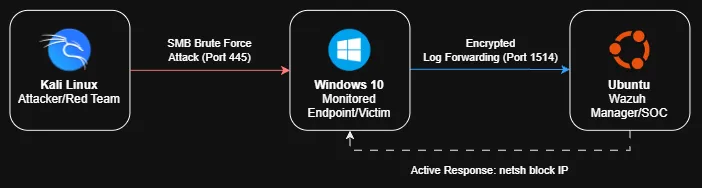
📝 Environment Note: Because this lab was built in a dynamic home-lab environment and conducted across multiple sessions, the IP addresses shown in the screenshots may vary slightly from the architecture table.
- Attacker (Kali):
10.x.x.x - Target (Windows):
10.x.x.x - Wazuh Manager (Ubuntu):
10.x.x.x
The core detection and correlation logic remains identical regardless of the IP lease.
Click to view raw telemetry flow
[Kali Linux] --(Attack Traffic)--> [Windows 10]
                                        |
                               (Security Events)
                                        |
                                        v
                                 [Wazuh Agent]
                                        |
                               (Encrypted Log Forwarding - Port 1514)
                                        |
                                        v
[Windows Firewall] <--(Active Response)--- [Wazuh Manager (Ubuntu)]
🔐 Scenario 1: File Integrity Monitoring (FIM)
Objective: Verify real-time detection of unauthorized modifications to critical system files.
Methodology:
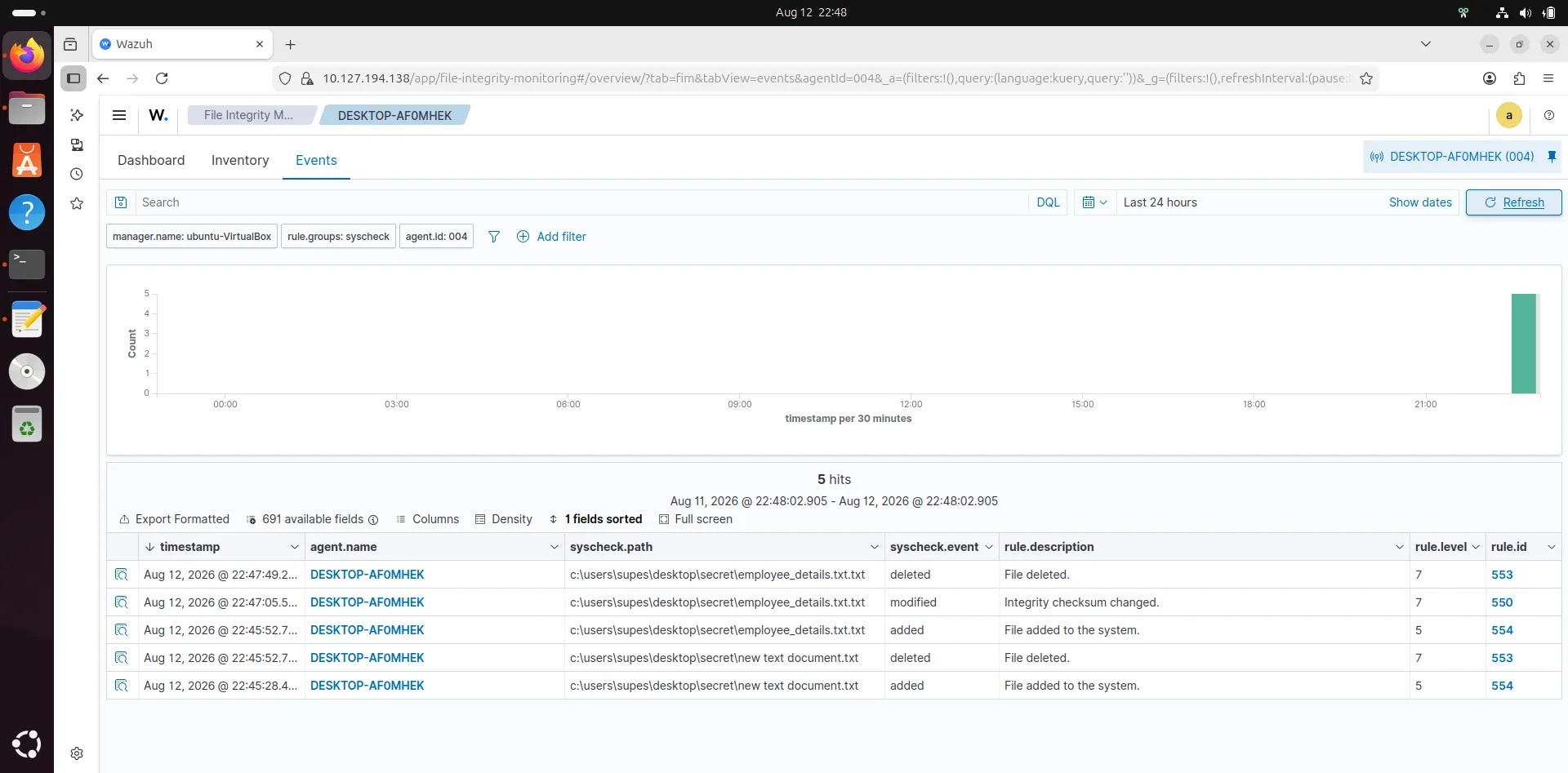
The Wazuh Agent was configured to actively monitor critical Windows directories, in this lab secret folder. When a file is modified, the agent computes the cryptographic hash and forwards the anomaly to the Manager.
Result: The FIM pipeline successfully captured unauthorized file modifications, instantly flagging the exact file path, modification timestamp, and the specific changes made.
🔑 Scenario 2: SMB Authentication Attack (MITRE T1110)
Objective: Detect lateral movement attempts via SMB brute-force attacks and correlate them into high-severity alerts.
Attack Simulation: NetExec was deployed from Kali Linux to bombard the Windows endpoint (Port 445) with credential combinations.
Detection Logic:
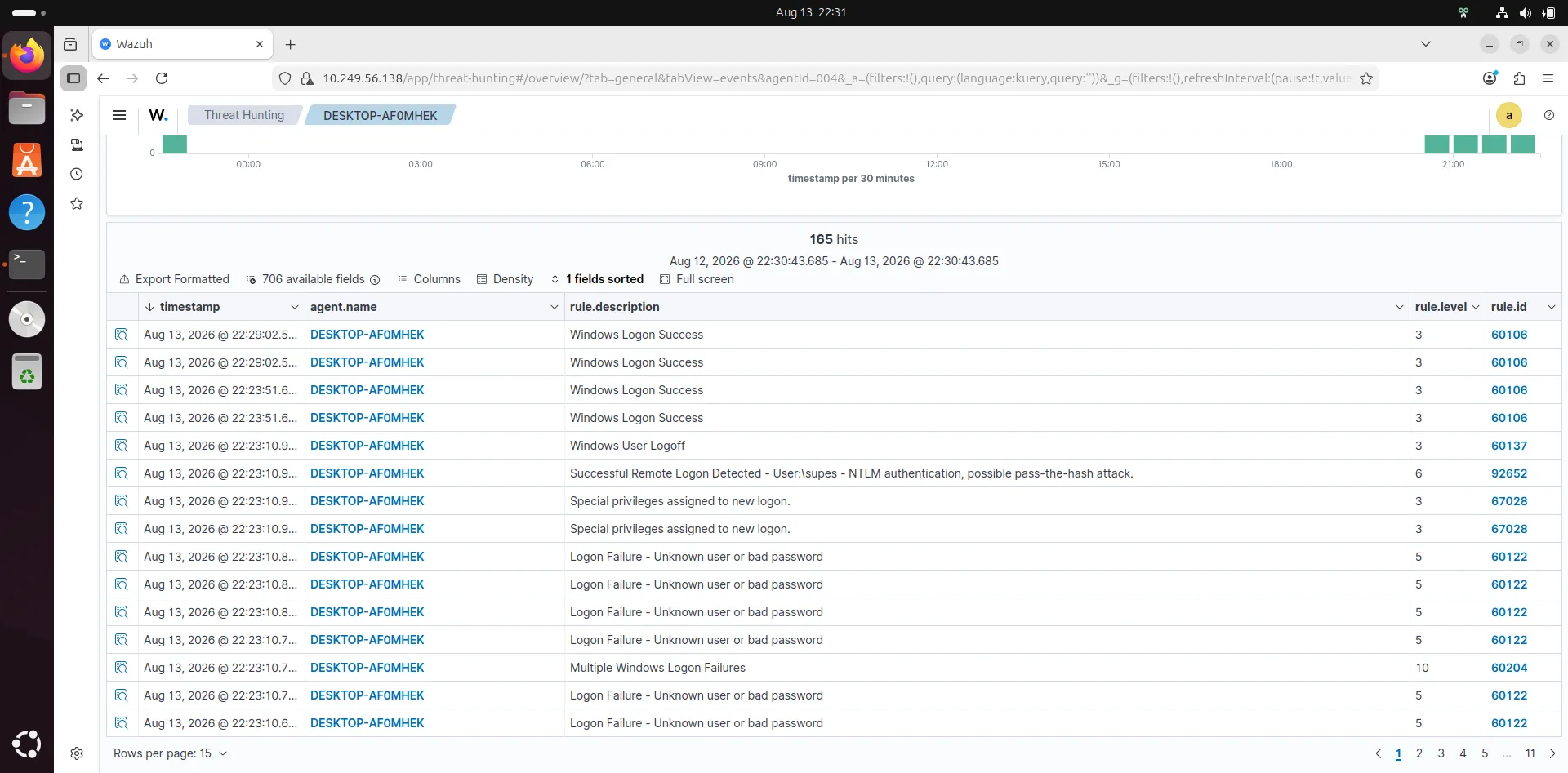
Instead of treating each failed login as an isolated event, Wazuh was utilized to correlate the telemetry. Rule 60204 was triggered, identifying multiple failed logons originating from a single source IP (10.x.x.x) within a 240-second window.
Rule ID:       60204
Level:         10
Description:   Multiple Windows Logon Failures
MITRE ATT&CK:  T1110 (Brute Force)
Result:
The SIEM successfully aggregated raw Windows Event ID 4625 logs into a unified, high-priority SOC alert.
🚨 Scenario 3: Automated Active Response (SOAR)
Objective: Move beyond passive detection by implementing a SOAR-like (Security Orchestration, Automation, and Response) mechanism to temporarily contain the threat.
Response Architecture:
The Wazuh Manager was programmed to execute a localized response on the Windows endpoint whenever Rule 60204 triggered.
<active-response>
    <command>netsh</command>
    <location>local</location>
    <rules_id>60204</rules_id>
    <timeout>300</timeout>
</active-response>
Result:
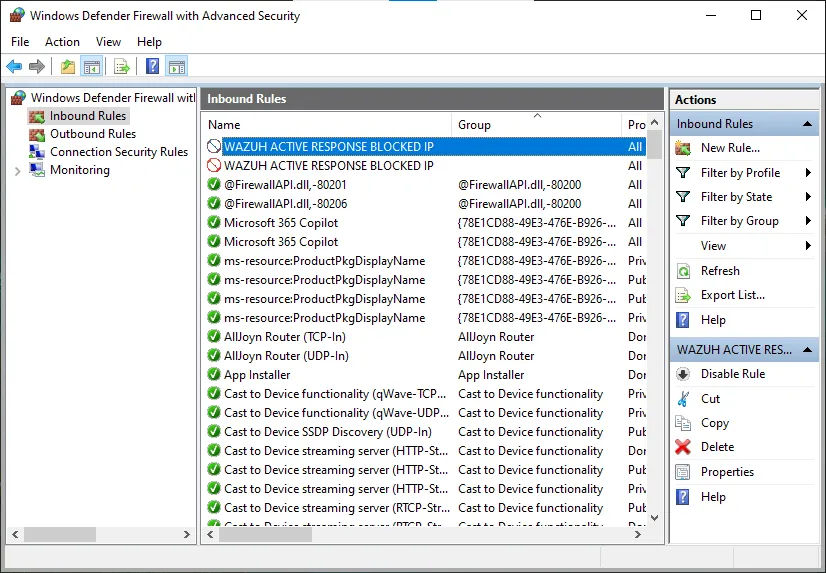
Once the attack reached the defined threshold, Wazuh automatically instructed the Windows agent to execute a netsh command. This instantly created an Inbound Block Rule in the Windows Defender Firewall against the Kali Linux IP.
The attack was neutralized mid-execution. After the 300-second timeout, the rule automatically dissolved, demonstrating a safe, temporary containment strategy that prevents permanent network lockouts during false positives.
🔎 Scenario 4: Gap Analysis (Network Reconnaissance)
Objective: Test the limits of endpoint-based monitoring against network-layer reconnaissance.
Experiment:
A stealth network scan was initiated from Kali Linux using nmap -Pn 10.44.158.101 to map exposed services (SSH, SMB, MSRPC).
Finding & Security Gap: The scan successfully enumerated the ports, but no obvious alert was generated in Wazuh.
Why? The current architecture relies heavily on endpoint logs (Windows Security Events). A port scan interacts with the network stack but does not typically generate a Windows authentication or file event.
Conclusion: This “failed” detection is a critical engineering finding. This demonstrates a visibility gap in an endpoint-focused monitoring architecture and motivates adding network telemetry such as NIDS.
💡 Key Takeaways
- Detection is Not Mitigation: Installing a SIEM provides visibility, but tying detection directly to an automated response (Active Response) is what actually stops a breach in its tracks.
- Telemetry Dictates Capability: The gap analysis proved that you can only detect what you can see. Endpoint logs are blind to pure network reconnaissance.
- Safe Containment: Implementing a timeout-based response (300 seconds) is crucial in production environments to avoid self-inflicted Denial of Service (DoS) due to false positives.
🚀 The Roadmap: Next Phase
To evolve this miniature SOC into an enterprise-grade architecture, the following capabilities are planned for the next iteration:
- Network Intrusion Detection (NIDS): Integrating Suricata or Zeek to inspect raw packet traffic and cover the blind spot discovered during the Nmap gap analysis.
- Cloud Integration: Extending the Wazuh Manager to ingest cloud-native telemetry (e.g., AWS CloudTrail, VPC Flow Logs) to monitor hybrid-cloud environments.
- Alert Notification: Pushing high-severity alerts from Wazuh to a Slack or Telegram webhook for real-time SOC analyst notification.
This project is a continuous work in progress, demonstrating a hands-on approach to threat detection engineering and incident response.