OSINT Investigation: Profiling a Cyber Threat Actor
📌 Project Description
In cybersecurity and law enforcement, Open Source Intelligence (OSINT) is a critical methodology used to deanonymize threat actors and map their digital footprints. This project demonstrates an end-to-end OSINT investigation starting from a single alias to building a comprehensive intelligence dossier on a person-of-interest (POI).
The objective was to track an individual associated with a hacking group that recently compromised a Managed Service Provider (MSP) and attempted to sell stolen credentials. By pivoting through social media, blogs, and encoded data, I successfully uncovered the attacker’s real identity, location, and employment details.
🛠️ Tools & Methodology
- Tools: urlscan.io, CyberChef, Google Dorking, Isolated Virtual Machine (VM).
- Concepts: Operational Security (OpSec), Link Analysis, Hexadecimal Decoding, Cross-Referencing, Identity Deanonymization.
🏢 Business Scenario
Working alongside a law enforcement organization, I was assigned to track a POI known by the Twitter/X handle @sp1ritfyre. While another team handled the dark web leads regarding the stolen MSP credentials, my task was to utilize clear-net OSINT sources to build a profile on the individual. The goal was to connect the alias to a real-world identity and locate any evidence linking them to the breach.
🚀 Investigation Phases
Phase 1: Initial Pivot & Sandboxed Link Analysis
- Alias Reconnaissance: The investigation began with the provided Twitter handle
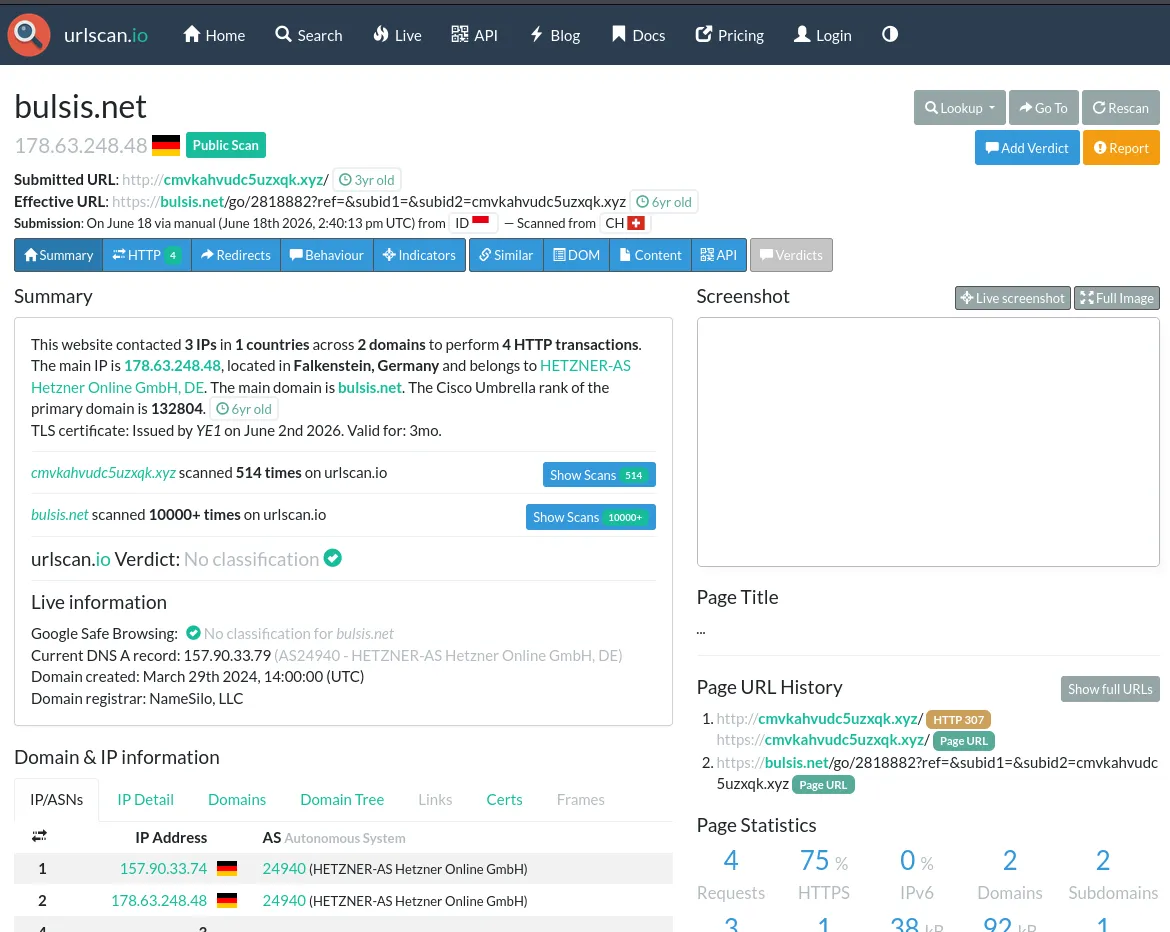
@sp1ritfyre. The account itself had minimal activity, but a URL in the bio section warranted further inspection. - OpSec & Sandboxing: Adhering to strict Operational Security (OpSec), I refused to click the unknown link directly. I first scanned it using urlscan.io, which revealed the site contacted 3 IPs across 2 domains. To verify the payload, I accessed the link from within a heavily isolated and monitored Virtual Machine (VM).
- Dead-End Discovery: The sandboxed visit revealed that the site hosted irrelevant, spammy content (tarot readings and gambling pages). Recognizing this as a dead-end or a decoy, I pivoted my investigation strategy back to search engine queries.
Phase 2: Cross-Referencing & Cryptographic Decoding
- Google Dorking: I conducted advanced searches for the alias
"Sp1ritFyre". This surfaced two critical leads: a Blogger.com profile and a standalone domain,redhunt.net. - Visual Correlation: Both websites utilized the exact same profile picture as the Twitter account. Furthermore, the footer of
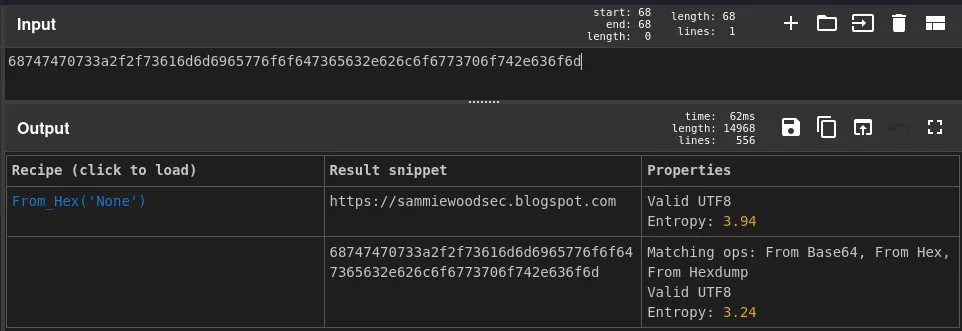
redhunt.netexplicitly contained the name “Sp1ritFyre”, confirming asset ownership. - Data Extraction & Decoding: The Blogger profile revealed an email address (
d1ved33p@gmail.com). Interestingly, the “Location” field contained a hexadecimal string instead of a geographic location. I utilized CyberChef to decode the hex value, which translated to an blogspot URL:https://sammiewoodsec.blogspot.com.
Phase 3: Identity Resolution & Profiling
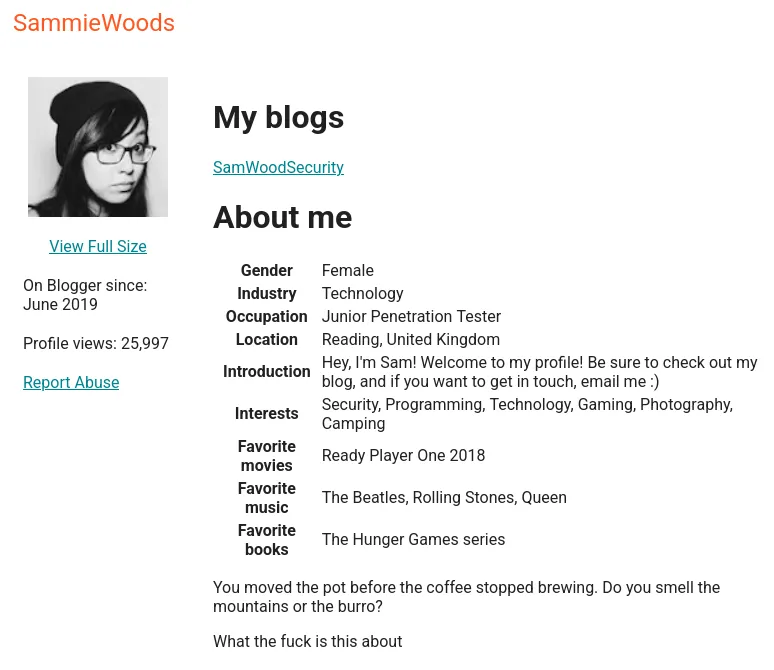
- Full Profile Extraction: By exploring the newly discovered blog and clicking the profile on Blogger, I cross-referenced the email, gender hints, and professional background, successfully extracting the complete personal details of the threat actor.
🎯 Results: Threat Actor Intelligence Dossier
Through methodical OSINT pivoting, I successfully deanonymized the threat actor and compiled the following intelligence dossier for law enforcement:
- Target Identity: Sammie Woods
- Age / Location: 23 Years Old | United Kingdom
- Employment: Junior Penetration Tester at PhilmanSecurityInc
- Owned Domain:
https://redhunt.net - Associated Blogs:
https://sammiewoodsec.blogspot.comhttps://sp1ritfyrehackerstories.blogspot.com
- Associated Email:
d1ved33p@gmail.com - Key Interests: Security, Photography, Gaming, Camping
Key Takeaways
- Operational Security (OpSec): Demonstrated safe investigation practices by utilizing
urlscan.ioand isolated Virtual Machines when handling potentially malicious links. - Analytical Pivoting: Showcased the ability to take a single, obscure artifact (a Twitter handle) and chain it across multiple platforms (Blogger, CyberChef) to uncover a real-world identity.