Identity and Access Management (IAM) & Role-Based Access Control (RBAC) Implementation
📌 Project Description
Cloud infrastructure security begins with robust identity management. This project demonstrates the implementation of AWS Identity and Access Management (IAM) to architect a security posture based on the principles of Least Privilege and Role-Based Access Control (RBAC).
Through this project, I engineered account-level security guardrails (password policies), configured user groups with highly specific permissions (utilizing both Managed and Inline Policies), and conducted authorization testing to ensure strict Separation of Duties (SoD) within a production-like environment.
🛠️ Tech Stack & AWS Services
- Security, Identity, & Compliance: AWS Identity and Access Management (IAM).
- Target Services: Amazon EC2, Amazon S3.
- Concepts: Role-Based Access Control (RBAC), Least Privilege, Separation of Duties (SoD), AWS Managed Policies vs Customer Inline Policies, Password Hardening.
🏢 Business Scenario
A rapidly growing tech enterprise is aggressively scaling its utilization of Amazon EC2 and Amazon S3. As the IT staff expands, utilizing highly-privileged (root/admin) credentials across the board poses a catastrophic security risk. The enterprise requires a centralized authorization framework where staff are granted access exclusively to the resources required for their specific job functions:
- S3 Support Staff: Restricted to viewing S3 buckets and objects only.
- EC2 Support Staff: Restricted to monitoring EC2 dashboards with explicit denial of server state modification rights.
- EC2 Administrators: Granted full lifecycle management rights (start/stop) over EC2 instances.
🚀 Implementation Steps
Phase 1: Account Security Hardening (Password Policy)
- Enforced a custom account-level password policy to mandate security compliance.
- Configured strict parameters: Minimum 10 characters, requiring a combination of uppercase, lowercase, numeric, and non-alphanumeric characters.
- Implemented credential rotation lifecycle (90-day expiration) and prevented the reuse of the last 5 passwords.
Phase 2: RBAC Architecture Design (User Groups & Policies)
- Audited and analyzed logical user groups:
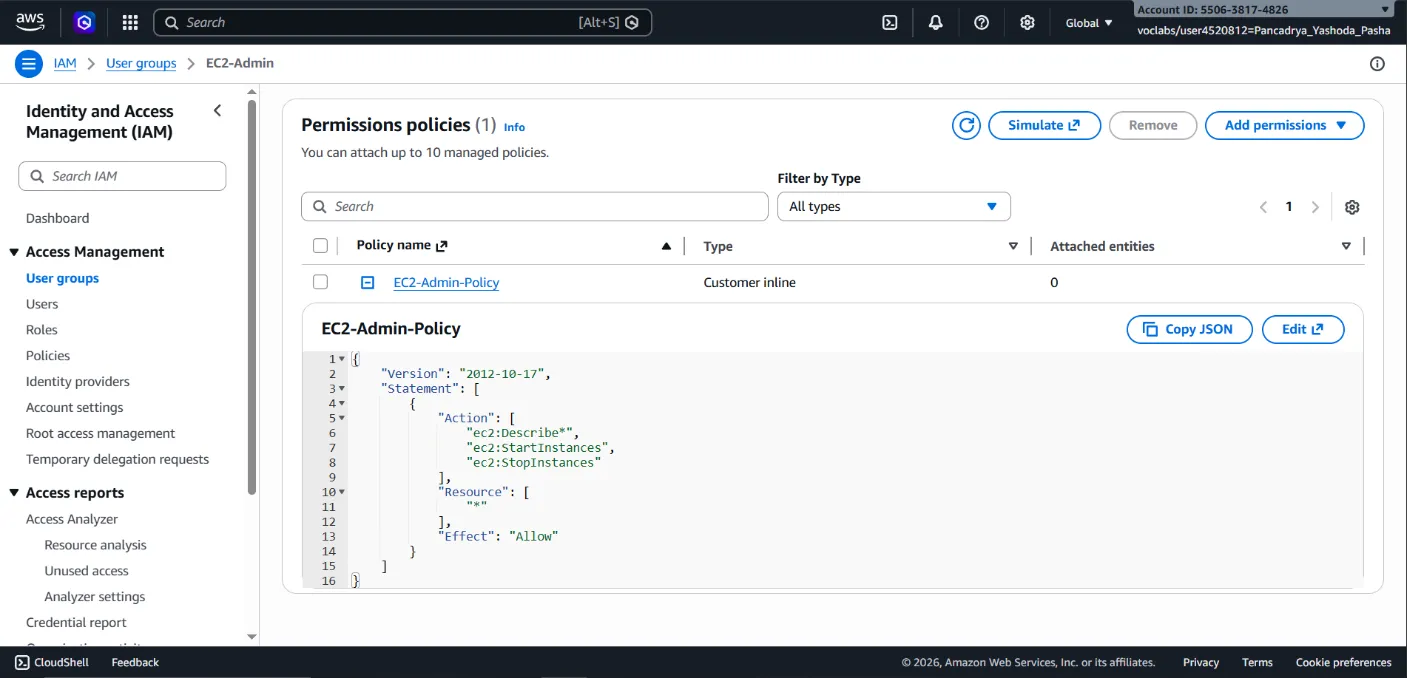
S3-Support,EC2-Support, andEC2-Admin. - Applied AWS Managed Policies (
AmazonS3ReadOnlyAccessandAmazonEC2ReadOnlyAccess) for the Support tiers, ensuring automatic policy updates mapped by AWS. - Engineered a highly granular Customer Inline Policy (
EC2-Admin-Policy) specifically for the Administrator group to strictly governec2:Describe*,ec2:StartInstances, andec2:StopInstancesAPI actions.
Phase 3: Identity Mapping (User Assignment)
- Allocated IAM identities (
user-1,user-2,user-3) into their respective groups based on operational roles. - Avoided attaching policies directly to IAM users (user-level), adhering to best practices by governing permissions at the group level for enterprise scalability.
Phase 4: Access Validation & Penetration Testing
- Conducted logical testing (authenticating as individual users via the custom IAM sign-in URL) to validate the integrity of the security posture.
- user-1 Validation (S3 Support): Successfully accessed S3 buckets but received an Access Denied API response when attempting to access the EC2 console.
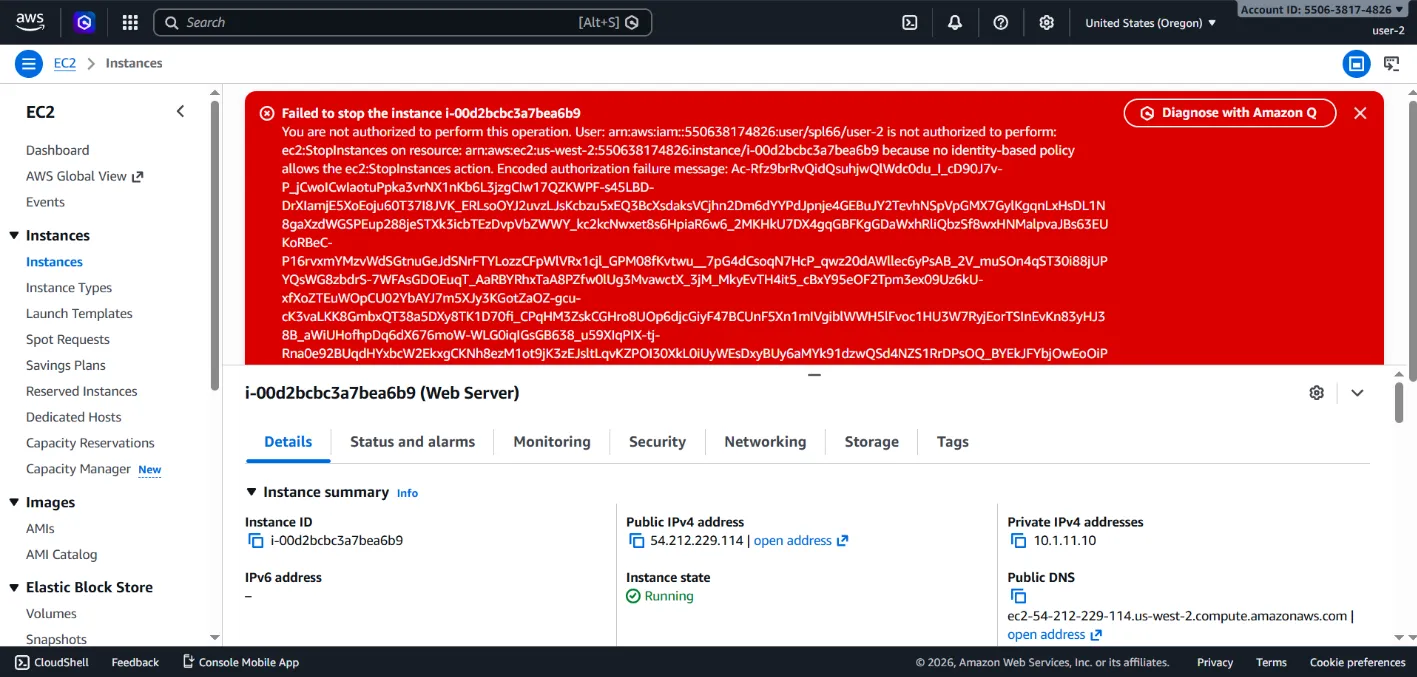
- user-2 Validation (EC2 Support): Successfully visualized EC2 metrics and instance lists, but API calls were explicitly blocked when attempting to execute a
Stop Instanceaction. - user-3 Validation (EC2 Admin): Successfully executed infrastructure intervention by legally invoking the Stop state on an EC2 instance.
🎯 Results & Key Takeaways
- Least Privilege Enforcement: Successfully mitigated internal/external exploitation vectors by strictly confining access scopes to exact job requirements.
- Access Management Scalability: Championed the use of User Groups (RBAC) over individual permissions, enabling the organization to onboard/offboard staff securely and efficiently at scale.
- Enterprise Compliance: Hardened password policies ensured the AWS account adheres to standard security control frameworks (e.g., SOC2, ISO 27001).