Custom VPC Architecture & Secure Network Design on AWS
📌 Project Description
Cloud infrastructure security inherently begins at the network layer. This project demonstrates the from-scratch architectural design and implementation of a custom Amazon Virtual Private Cloud (VPC). The primary focus is establishing a logically isolated network environment by strictly decoupling public and private resources and enforcing rigorous network traffic controls.
Throughout this experiment, I provisioned Public and Private Subnets, engineered Route Tables, established secure outbound internet access for private workloads via a NAT Gateway, and deployed a Bastion Host (Jump Box) to facilitate secure remote administration into the private network tier.
🛠️ Tech Stack & AWS Services
- Networking & Content Delivery: Amazon VPC, Public & Private Subnets, Internet Gateway (IGW), NAT Gateway, Route Tables.
- Compute: Amazon EC2 (Bastion Host & Private Instances), EC2 Instance Connect.
- Security: VPC Security Groups, Secure Shell (SSH) Access Control.
- Concepts: Network Isolation, Routing, Secure Remote Access (Jump Box), Outbound-Only Internet Access.
🏢 Business Scenario
An enterprise requires a secure cloud environment to host its internal applications and databases. Deploying all servers on a public-facing network poses an unacceptable security risk. To mitigate this, the network architecture was designed to segregate servers into two distinct tiers:
- Public Tier: Houses only resources that require direct inbound internet access (e.g., Load Balancers or Bastion Hosts).
- Private Tier: Houses backend application servers and databases. This tier is completely shielded from inbound internet access but retains the ability to securely download external software updates via a proxy.
🚀 Implementation Steps
Phase 1: Network Scoping (VPC & Subnet Design)
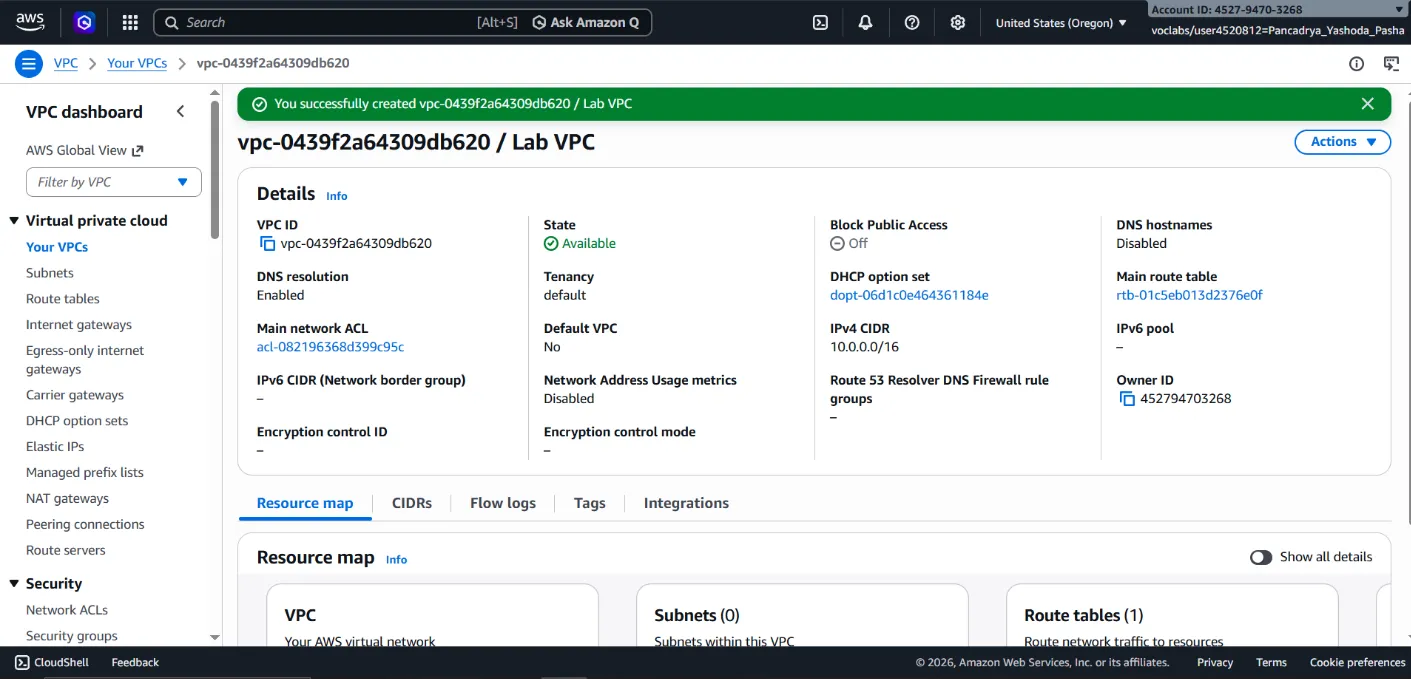
- Allocated a custom IPv4 CIDR block (
10.0.0.0/16) for the Lab VPC, enabling DNS hostname resolution to ensure seamless internal routing. - Partitioned the VPC network into two highly specific subnets within the same Availability Zone:
- Public Subnet (
10.0.0.0/24): Configured to automatically assign public IPv4 addresses to launched instances. - Private Subnet (
10.0.2.0/23): Designed with a larger capacity (512 IP addresses) to accommodate backend workloads, strictly without public IP assignments.
- Public Subnet (
Phase 2: Public Internet Connectivity (IGW & Route Tables)
- Provisioned an Internet Gateway (IGW) and attached it to the custom VPC.
- Engineered a Public Route Table, injecting a static route (
0.0.0.0/0) that directs all internet-bound traffic to the IGW. - Explicitly associated the Public Subnet with this Public Route Table, establishing bidirectional internet connectivity for the public tier.
Phase 3: Secure Remote Administration (Bastion Host Provisioning)
- Launched an Amazon EC2 instance (Amazon Linux 2023) within the Public Subnet to act as a Bastion Server (Jump Box).
- Hardened the Bastion Server’s Security Group to strictly accept inbound SSH traffic (Port 22) only from authorized connection sources.
Phase 4: Private Outbound Internet Access (NAT Gateway)
- Deployed a NAT Gateway within the Public Subnet and allocated it a static Elastic IP address.
- Modified the Private Route Table to route all outbound internet traffic (
0.0.0.0/0) from the Private Subnet to the NAT Gateway. This mechanism allows private instances to download external updates without exposing themselves to unsolicited inbound internet connections.
Phase 5: Penetration and Connectivity Validation (Advanced)
- Launched a test instance (Private Instance) exclusively within the Private Subnet, configuring its Security Group to only accept inbound SSH connections originating from the internal VPC CIDR (
10.0.0.0/16). - Executed secure network penetration: Connected to the Bastion Host via EC2 Instance Connect, then performed an SSH-jump directly into the private IP address of the Private Instance.
- Validated NAT Gateway functionality by executing a
ping -c 3 google.comcommand from within the private instance, successfully verifying that ICMP echo responses were returned (proving the system could securely communicate with the outside world).
🎯 Results & Key Takeaways
- Network Isolation (Defense in Depth): Successfully shielded backend compute infrastructure from direct public internet exposure, drastically reducing the overall attack surface.
- Centralized Administrative Access: Implemented a Bastion Host architecture, providing a single, heavily monitored, and auditable entry point for managing private backend servers.
- Precision Traffic Control: Demonstrated strong proficiency in manipulating Route Tables and Gateways (IGW & NAT) to dictate exact traffic flows in alignment with rigorous security architectures.