Containerized App Migration to AWS Managed Services
📌 Project Description
Manually orchestrating Docker containers on bare virtual instances (IaaS) often results in significant operational overhead. This project demonstrates the architectural migration from self-managed containers to AWS Platform as a Service (PaaS) and Serverless solutions to minimize maintenance burdens and automate scalability.
The core focus of this project is deploying a containerized Node.js application using AWS Elastic Beanstalk, migrating the relational data tier to Amazon Aurora Serverless, and integrating the backend services with a static frontend utilizing Amazon API Gateway.
🛠️ Tech Stack & AWS Services
- Compute & Container Management: AWS Elastic Beanstalk, Amazon Elastic Container Registry (ECR), Docker.
- Database: Amazon Aurora Serverless v2 (MySQL-Compatible).
- Networking & API: Amazon API Gateway, Amazon VPC.
- Concepts: PaaS (Platform as a Service), Serverless Databases, Stateful vs Stateless Architecture, Microservices Integration.
🏢 Business Scenario
A web application (Coffee Suppliers App) was initially running entirely within Docker containers, including its MySQL database. However, running a relational database (which is inherently stateful) inside a dynamic container poses high risks to data persistence and reliability. To prepare for business growth, the architecture was re-engineered:
- Database Layer: Migrated to Amazon Aurora Serverless to seamlessly scale compute capacity up or down based on transaction load, optimizing costs during idle periods.
- Web Tier: The stateless Node.js container was deployed to AWS Elastic Beanstalk, offloading load balancing and auto-scaling management entirely to AWS.
- Frontend Layer: Hosted securely on Amazon S3, configured to communicate with the backend via a managed Amazon API Gateway.
🚀 Implementation Steps
Phase 1: Serverless Database Migration (Aurora Serverless)
- Evaluated network topology to ensure the presence of subnets across multiple Availability Zones for High Availability.
- Provisioned an Amazon Aurora Serverless v2 (MySQL-compatible) cluster to replace the legacy containerized database.
- Hardened Security Groups to guarantee the database only accepts internal connections specifically from the application instances (
port 3306). - Interfaced with the Amazon RDS Query Editor and MySQL CLI to instantiate the schema (
suppliers,beanstables) and execute the initial data seeding process.
Phase 2: PaaS Container Deployment via Elastic Beanstalk
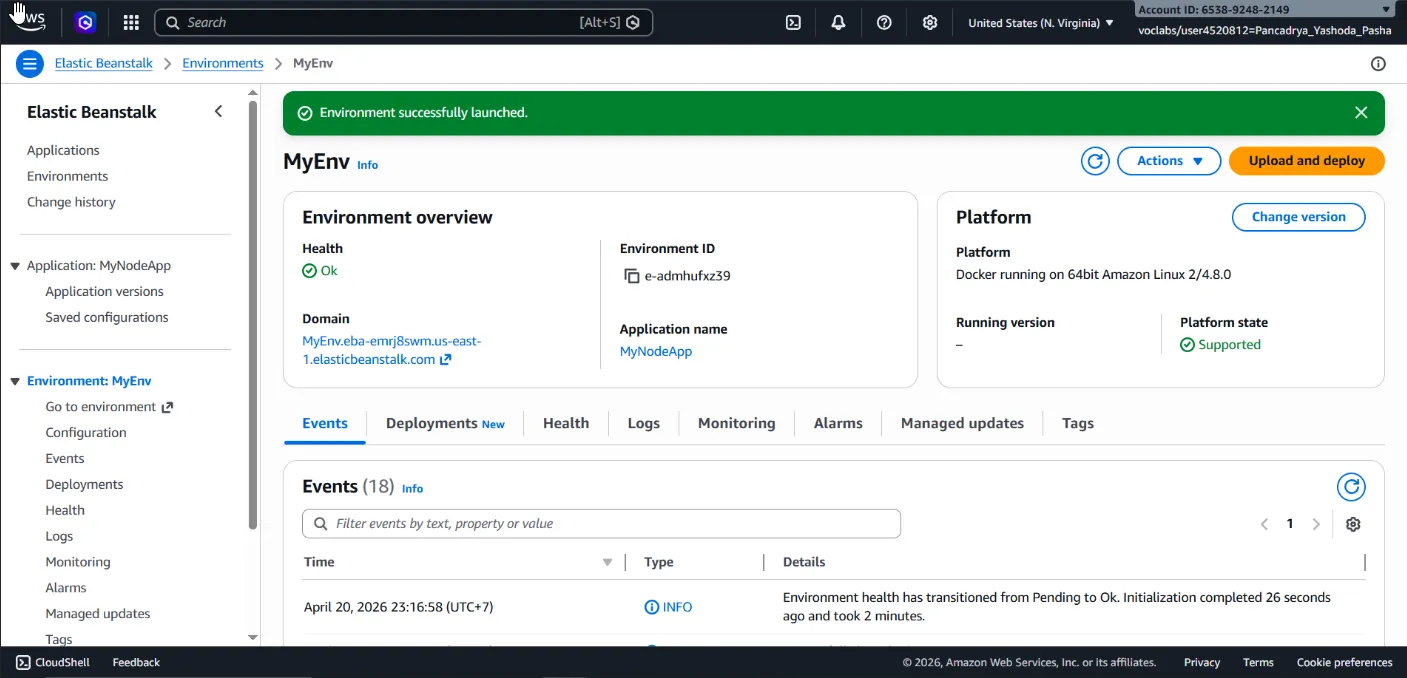
- Inspected and validated the Docker image of the Node.js application securely hosted within Amazon ECR.
- Configured the necessary IAM Role (
aws-elasticbeanstalk-ec2-role) to grant the Elastic Beanstalk environment the authorization required to pull images from the private ECR repository. - Automated the Elastic Beanstalk environment provisioning via the AWS CLI, injecting critical environment variables (such as
APP_DB_HOSTpointing to the Aurora Serverless endpoint). - Executed the deployment by crafting a
Dockerrun.aws.jsonfile, instructing Elastic Beanstalk to proxy incoming HTTP traffic from the native Load Balancer to the internal container port.
Phase 3: API Gateway Proxy Integration
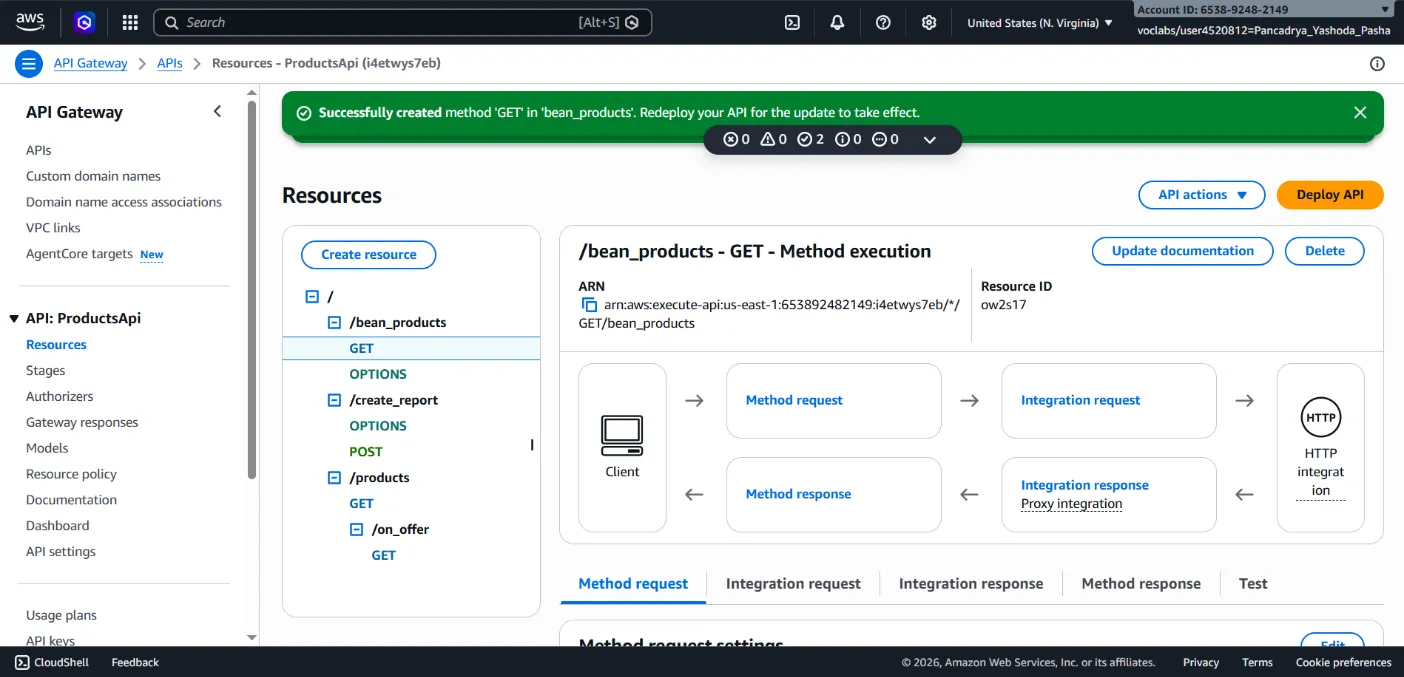
- Configured Amazon API Gateway to act as the intermediary layer between the frontend application (S3) and the Elastic Beanstalk backend.
- Provisioned a new resource (
/bean_products) and established aGETmethod utilizing HTTP Proxy Integration. - Pointed the proxy endpoint URL to the Elastic Beanstalk domain to seamlessly route JSON payloads.
- Enabled CORS (Cross-Origin Resource Sharing) and deployed the API to the production stage.
🎯 Results & Key Takeaways
- Architectural Modernization (Stateful vs Stateless): Demonstrated advanced architectural understanding by decoupling the stateless compute workloads (Docker/Elastic Beanstalk) from the stateful data storage (Aurora Serverless).
- Operational Overhead Reduction (NoOps): By leveraging Elastic Beanstalk and Aurora Serverless, the engineering team is relieved from manual OS patching, container orchestration, and database capacity planning.
- Microservices Integration: Successfully stitched together distinct managed services (S3 Frontend, API Gateway, Beanstalk Backend, Aurora DB) into a cohesive, secure, and highly scalable application ecosystem.